Showing posts with label Travel. Show all posts

Thursday, May 28, 2009

Guangzhou Safety

Subway safety is an important matter to think about and the subway system in Guangzhou, China is no different.  It’s pretty common to find the subway systems of the world plastering warning and rules signs all over the place telling you what is and what is not allowed.  The sign below from Guangzhou is pretty firm with its rules:

 Guangzhou2009 059

NO SMOKING

NO POISONOUS OR FLAMMABLE LIQUIDS.

NO PETS…

Guangzhou2009 060

NO BALLOON…

???

Huh?  And it’s not just any balloons, it’s apparently Mickey Mouse balloons that are the real dangerous threat!  How is it possible that something as pure, happy, and exciting as a balloon can get such a bad reputation?   How did this happen?  I know from my own experience I’ve always had an issue with balloon animals but it’s not the balloons that were the issue but the clown mutating those poor balloons that frightened me.  Maybe this is Guangzhou’s reasoning: if you keep the balloons away then you keep the creepy clowns away.  Clowns are frightening; there is something unnatural about anyone forcing you to be happy.  Keep those freaky clowns off the subway, that’s what I say!  Well done Guangzhou!

Monday, May 18, 2009

God Books

What I love about traveling to other countries are those small little differences that you may not notice unless you pay close attention. A good example of this is concerning books about religion. Most hotel rooms I've stayed in only have one religion book: the Christian bible. Our first hotel room in Japan, on the other hand, had not only the New Testament bible but also The Teaching of Buddha.

So many bedtime reading choices!

After debating which one I should read I opted to read a science fiction novel. Sorry God, no offence, but I really like robots!

Friday, May 15, 2009

Where’s Johnnie?

The Walk In Kyoto, Talk In English tour been privately operated since 1996 by Mr. Hajime Hirooka, better known as Johnnie Hillwalker. He is considered one of the best tour guides in Japan, with 48 years of tour guide experience. His walk has been acclaimed worldwide as one of the most unique tours in the world. With all this positive publicity surrounding the Johnnie Hillwalker tour, Aimee and I thought taking one his tours would be the best way to start our holiday in Kyoto, Japan. Once we arrived at the meeting place we knew we were in the correct location when we saw a horde of non-Japanese people standing around looking confused. Johnnie showed up and the tour began:

Japan2009 022

If you’re thinking, ‘Wow, Johnnie looks pretty young for someone with 48 years of touring experience. What’s his secret?’ Well, the secret is simply this: this man isn’t Johnnie. We arrived on the day, the only day, that Johnnie decided to take a day off. Talk about bad timing. I mean, Johnnie has been doing this particular tour for 13 years and of all the days he decided to take off it happens to be the day, the only day, that Aimee and I are able to take the tour. Talk about the unfairness of life! After I got used to the idea of taking a Johnnie Hillwalker tour with a non-Johnnie I found the tour to be quite interesting and educational.

The tour visits:
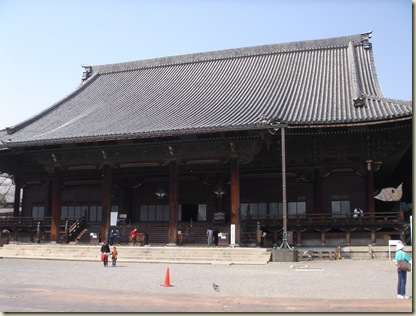
Japan2009 015

Higashi-Honganji, the biggest Buddhist temple.

Japan2009 067
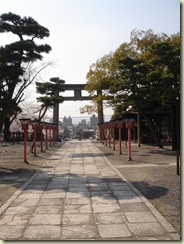
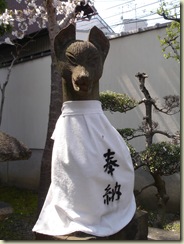
3 Shinto shrines, Ayako Tenman-gu, Ichihime shrine and Toyokuni shrine.

Shinto shrines are places of worship and the dwellings of the kami, the Shinto gods. Sacred objects of worship that represent the kami are stored in the innermost chamber of the shrine where they cannot be seen by anybody.

People visit shrines in order to pay respect to the kami or to pray for good fortune. New born babies are traditionally brought to a shrine a few days after birth, and many couples hold their wedding ceremonies there.
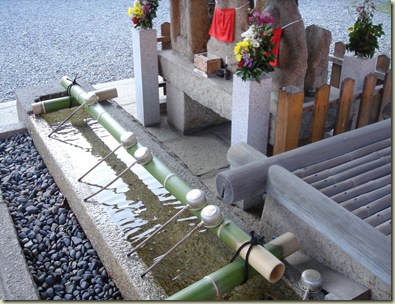
Japan2009 494

The purification trough is found near the entrance, the water of these fountains is used for purification (I assume you guessed that already given the name…). You are supposed to clean your hands and mouth before approaching the main hall.

Japan2009 059Japan2009 120

Shrine visitors write their wishes on these wooden plates and then leave them at the shrine in the hope that their wishes come true. Most people wish for good health, success in business, passing entrance exams, love or wealth.

Japan2009 063Different shrines offer ‘good fortune’ for different things in life. This particular shrine specialized in good luck charms for school kids who want to do well in their classes. If you spend 500 yen on one of these good luck charms you’re guaranteed to ace your final exams in school – well, at least that’s the theory. Aimee and I bought two good luck charms: one for the safe delivery of our baby, and another for the long and happy life for our baby. We don’t necessarily believe in good luck charms but it can’t hurt right?

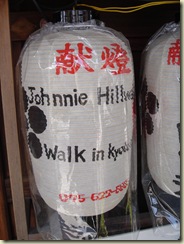
Japan2009 065Japan2009 068

Johnnie, the real Johnnie and not our replacement Johnnie, donated money to this shrine so he was given a lantern out front in his honor.

We also visited a former geisha area, Gojo rakuen which Replacement Johnnie told us, in a whisper, is now a prostitution area. REAL geisha’s still exist in Japan. Aimee and I saw a few but they’re incredibly difficult to take a picture of. Ever since that movie/book Memoirs of a Geisha Japan has had an increase of foreigners camping outside geisha houses trying to get a photograph. Because of this, all geisha now have bodyguards and personal chauffeurs who quickly pick them up and race them away before any pictures can be taken. There was even an article in the local newspaper pleading foreigners to leave the geisha alone. Man, it really makes me hate those damn tourists … but, of course, I became one those annoying tourists when I saw my first geisha. I pulled out my camera but she was super fast. She zipped passed me using her magical geisha powers and I missed out on getting a shot of her. Anyway, enough about geisha.

Japan2009 083
We visited graveyards in Renkoji and Chokodo Temples. Those long slender boards you see in the photos are, in a way, a guestbook signing of who visited the grave and when they came. Many of these boards were old suggesting no one has visited most of the graves recently. Monks visits the graveyards almost everyday but they don’t leave the boards.

The tour was good because it took us into areas normal guide books never tell you about. We went to four workshops in private homes and along back alleys where such things as Buddhist prayer beads, paper fans, tofu, paper lanterns, rope decorations, green tea containers, Japanese pastries and pottery are made.

Japan2009 048We spent ten minutes watching these two make paper fans by hand.

It was a great tour and an awesome way to start off our Kyoto holiday. I often wonder though how different an actual Johnnie Hillwalker tour would have been. Replacement Johnnie was great but you’re always left wondering what you missed right? Below are some additional pictures I took during the tour:

Japan2009 124 Japan2009 077 Japan2009 088

Monday, May 11, 2009

The Golden Pavilion

The Temple of the Golden Pavilion, formally known as Rokuon-ji, is the most popular tourist attraction in Kyoto. The pavilion was originally built as a retirement villa for Shogun Ashikaga Yoshimitsu in the late 14th century, and converted into a temple by his son. However, the pavilion was burnt down in 1950, by a young monk who had become obsessed with it. 

Although all of the buildings on the temple’s site have been reconstructed, the garden remains as it was in former days and can be enjoyed as it was hundreds of years ago.

Rokuon-ji Temple was inscribed as World Cultural Heritage in 1994.

Monday, May 4, 2009

Ryoanji Temple

Ryoanji Temple in Kyoto, Japan is famous for its Zen garden, which is considered to be one of the most notable examples of the "dry-landscape" style.  Look  up Ryoanji Temple in any travel website or tour guide and you will find excited ravings about how amazing the Ryoanji Zen garden is.  So, I don’t know if I had my expectations too high but honestly, I was a little disappointed.  Let’s take a look: 

DSC01861 

Walking up the steps of Kuri, the main building of the temple.  Our exciting Zen experience awaits!

23212753.KyotoRyoanjiZenGarden031978

See this picture?  Imagine 15 rocks artistically placed randomly in white gravel and you’ve pretty much summed up the Ryoanji Zen rock garden.  No trees, barely any grass, no trickling water, just rocks and gravel.  Sure, they’ve drawn some nice pretty circles in the white gravel but it’s pretty much just rocks and gravel.  Wow! And apparently this Zen garden has been wowing the masses since 1525! 

Japan2009 342 

Speaking of the masses, people come from far and wide to see these rocks (we did after all).  They don’t just look at the rocks, they sit and contemplate the rocks for hours!  During our brief visit to the Zen garden (which we had to pay 500 yen to see by the way) I started looking at the faces of the people sitting and admiring the rocks.  I’ve never seen so many blank-faced-zoned-out people in my life.  It was like an alien spaceship came down to the Ryoanji temple, landed, sucked out the brains on the poor tourists and locals that were there, and left a few rocks as payment.  These people were seriously pondering the meaning of life, the universe, and everything while sitting with their Zen rock spirit guides.  I have nothing against this of course.  I think it’s awesome these people were finding the Zen garden to be filled with so much peace and tranquility.  I just found the whole thing rather surreal.  Surreal but pretty damn peaceful! 

I 

There’s a famous vegetarian restaurant on the temple grounds called the Ryoanji Seven Herb Tofu.  The “O” on the noren curtain above signifies affability and an earnest hope for peace and harmony in the world – one cube of tofu at a time (oh, in case you’re wondering, I added the last little bit)! 

 Japan2009 368 

The name, Ryoanji Seven Herb Tofu is not only the name of the restaurant but it’s pretty much a spot on description of the menu.  Seven Herb Tofu…that’s pretty much it.  The tofu is boiled in plain water and served to you with a dipping sauce made out of soy sauce and seven herbs (mystery herbs just like KFC).  Some people may find it too simple and too bland tasting but since I’m a fan of tofu I loved it.  It was a nice refreshing lunch.

Japan2009 370 Japan2009 366

Especially when I washed it down with great tasting hot sake!

Thursday, April 30, 2009

Astro Boy

Astro Boy is a Japanese manga/anime character first introduced in 1963.  I remember in the 1970s they were broadcasting English dubbed versions on a couple Canadian television stations so as a kid I was well aware, and excited by, Astro Boy’s existence.  Because of this early childhood fascination with Astro Boy it was quite fitting for him to be the first character I saw once we exited the Kyoto train station.  Memories of running around the house in pulled up red socks flooded back to me when I saw our robot friend here:

Japan2009 296

Since we’re on the theme of manga (Japanese comic books) and anime (Japanese animation), I had the pleasure of going to the Kyoto International Manga Museum. 

  Beyond Japanese manga the museum also featured several exhibits dedicated to other forms of comics books internationally.  My personal childhood favorites, Tintin (Belgian) and Asterix (France) were featured as well as the original Smurf comics from Belgian.  The international selection of manga was small in comparison to the Japanese offerings.  The Kyoto International Manga Museum is essentially a huge, multi-floored library where you can go in and read comics.  If you’re a comics fan, this place is a dream come true.  A annual membership allows you unlimited access all the manga in the building.  As you can see by the photographs below, the walls are lined with thousands of manga!


Thank you Kyoto for bringing back that carefree, excitable kid in the silly red socks!

No, I’m not wearing my Astro Boy red socks in this photo but if I remember correctly, I was wearing some pretty snazzy red undies!

Japan2009 441

Cherry Blossoms

April is cherry blossom season in Kyoto, Japan.  It seems every tourist in the world had the same idea as us to go to Japan during this time.  Hotels were impossible to book but finally, after a week of searching, we located a hotel in central Kyoto.  I’m glad we were able to book this one hotel because without it, we were debating on altering our travel plans and go somewhere else.  I’m glad we didn’t, Kyoto, Japan in April is an amazing and beautiful sight to see!  The photographs below were taken in various parks, streets, and temples throughout the greater Kyoto area.  Beyond the stunning cherry blossoms in the photos you may also notice another important happening:  Aimee’s pregnant!  That’s right, our son isn’t even born yet and he has already been to Kyoto, Japan.  Not only Kyoto, but also Canada, Philippines, China, and Hong Kong.  Lucky kid!  He’s been to more international places as a fetus than I was within the first 25 years of my life!  I hope he enjoyed the cherry blossoms; Aimee and I certainly did!  Take a look:

Japan2009 497 Japan2009 044 Japan2009 112 Japan2009 167 Japan2009 169 Japan2009 172 Japan2009 197 Japan2009 224 Japan2009 399 Japan2009 401 Japan2009 408 Japan2009 410 Japan2009 411 Japan2009 415  Japan2009 448 Japan2009 458

Japan2009 446